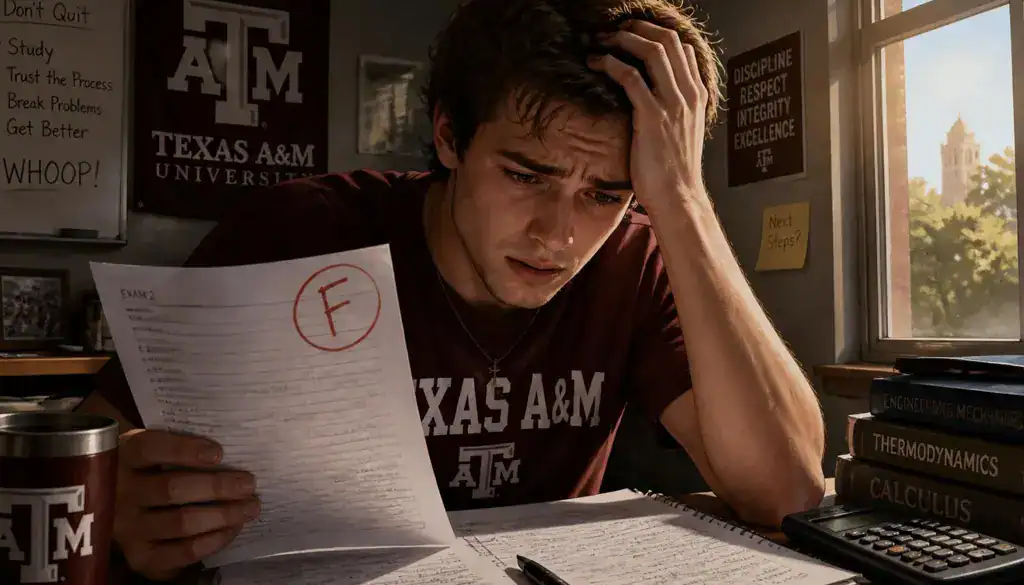
One bad exam doesn’t end your semester — here’s the 24-hour plan that gets most students back on track.
Let me guess: you refreshed the grade portal, saw the number, and your stomach dropped. Maybe it’s a 52. Maybe it’s worse. You’re already doing the math on your final grade in your head, and it’s not looking good. Take a breath — one exam grade almost never decides a course, and panicking right now is the one thing guaranteed to make your next exam worse, not better.
I’m Alex. I tutor TAMU and Blinn students in Bryan-College Station, and “I just failed an exam, what do I do” is one of the messages I get the most — usually within an hour of grades posting. This post is what I’d tell you in that first session: what to actually do in the next 24 hours, how to talk to your professor without it sounding like you’re begging for points, and the plan that gets most of my students back on track before the next exam.
Give Yourself 24 Hours — But Not More
Here’s the part nobody tells you: the exam is already over. Nothing you do in the next hour changes that grade. What it does change is everything that happens after it — and most students blow that window in one of two ways. Either they spiral for a week, checking the grade portal on repeat and telling themselves the semester is ruined, or they slam the door on it completely and walk into the next exam having changed nothing.
Give yourself real time to feel bad about it — today, maybe tomorrow. Text a friend, vent, be annoyed. Then put a hard stop on it. Twenty-four hours is enough to process a bad grade. After that, every hour you spend re-reading the exam and feeling worse is an hour you’re not spending figuring out what actually went wrong.
A bad exam grade is data, not a verdict. What you do with it in the next 24 hours matters more than the number itself.
Find Out Exactly What Went Wrong (Before You Do Anything Else)
Most students look at a failed exam and think “I’m just bad at this class.” In years of tutoring TAMU and Blinn students, I can count on one hand how many times that was actually true. Almost every failed exam breaks down into one of three problems, and the fix is completely different for each one:
- Content gaps — you genuinely didn’t know the material, even if you thought you did while studying
- Timing or test anxiety — you knew the material but ran out of time, froze on a hard problem, or blanked under pressure
- Careless errors — sign mistakes, misreading the question, rushing the easy points to “save time” for the hard ones
Go through your exam problem by problem — not just the score — and label every point you lost with which of these three it was. If it’s mostly content gaps, you have a studying problem. If it’s mostly timing, you have a practice-under-pressure problem. If it’s mostly careless errors, you have a slow-down problem. Three different diagnoses, three different fixes. Treating a timing problem like a content problem is how you end up “studying harder” and getting the same result on the next exam.
Don’t just look at your score. Look at why each point was lost. That’s the difference between studying more and studying differently.
Talk to Your Professor (The Right Way)
TAMU professors and TAs hold office hours for exactly this reason, and almost nobody uses them after a bad exam. Go — in person if you can, over Zoom if that’s what’s offered. Bring your actual exam and ask to go through it together.
⚠️ IMPORTANT: Don’t email asking for points back. Ask to review the exam and find out what a strong answer would have looked like. Professors respond very differently to those two emails — one sounds like you’re negotiating, the other sounds like you’re actually trying to learn.
If you can’t make office hours, a short email works. Something like:
“Hi Professor [Name], I didn’t do as well as I wanted on Exam [X] and I want to make sure I understand where I went wrong before the next one. Do you have 10 minutes during office hours this week to go over a couple of the problems I missed?”
That email gets answered. “Can I get partial credit back” usually doesn’t.
Check Where You Actually Stand in the Course
If you failed an exam, before you assume the semester is over, do the actual math. Most gateway courses at Texas A&M — MATH 151, MATH 152, MATH 308, PHYS 206, PHYS 218, CHEM 107 — run three or four in-term exams plus a cumulative final, and every syllabus lists exactly how each one is weighted. Pull it up and plug in real numbers: your actual grade so far, and a few realistic scenarios for what’s left.
One bad exam in a course with four exams and a final is rarely the difference between passing and failing the class — it’s usually the difference between an A and a B, or a B and a C. That’s a very different problem to solve than “I’m failing this class,” and it’s one more exams and a strong final can absolutely fix.
If you want the exact exam-by-exam breakdown for your course, I’ve written full guides for the classes I get the most calls about: MATH 151, MATH 152, MATH 308, PHYS 206, PHYS 218, CHEM 107, and the Math Placement Exam (MPE).
Do the math before you panic. A 45 on one exam out of four almost never means you’re failing the course — it means the average needs work, and there’s still time to move it.
Build Your Comeback Plan

Once you know what went wrong, the fix is the same for almost every student I work with — it just looks different depending on which of the three problems (content, timing, or careless errors) you’re solving.
- Day 1–2: Redo every problem you missed, from scratch, closed notes — not just reading the solution
- Day 3–4: Find new practice problems on the same topics from a different source (past exams, a study center, a textbook) so you’re not just memorizing the ones you’ve already seen
- Day 5 onward: Start the next unit with those gaps in mind — most courses build on themselves, so an unfixed gap from one exam shows up again on the next
- Every week: A 15-minute check against the syllabus — are you actually on pace, or just guessing?
None of this requires a tutor. It requires being honest about what the exam told you, and actually following through on it — which is the part most students skip.
When It’s More Than One Bad Exam
If this is your second or third rough exam in the same course, it’s not bad luck anymore — it’s a pattern, and it’s worth treating like one. That usually means one of two things: a study method that isn’t working, or a gap from an earlier course that never got fixed (Calc 1 gaps show up in Calc 2, Calc 2 gaps show up in MATH 308).
⚠️ IMPORTANT: Know your Q-drop deadline before you need it — check your academic calendar and talk to your advisor about where you actually stand. Dropping a course strategically is a normal, sane option, not a failure. Waiting until it’s too late to decide is the real mistake.
TAMU also has free resources built for exactly this situation — the Academic Success Center, department-specific help sessions, and Week in Review lectures depending on your course. Use them before spending money on anything else.
When Does Tutoring Actually Make Sense?
Honest answer: not always. If you failed an exam and haven’t tried the steps above yet — reworking the exam, talking to your professor, doing new practice problems under real exam conditions — start there first. A lot of students recover from one bad exam without ever needing outside help.
Where tutoring makes a real difference is when you’re already doing all of that and it’s still not clicking — when you can follow a solution but can’t produce one on your own, or when you’re too far behind to catch up by yourself before the next exam. That’s the point where an outside perspective, not more solo studying, is what actually moves the needle.
Bottom Line
You failed an exam. It feels like the end of the semester. It almost never is. The students I’ve seen turn it around aren’t the ones who panicked hardest or studied the most hours blindly — they’re the ones who figured out exactly what went wrong and fixed that specific thing before the next exam.
Whatever course brought you here — MATH 151, MATH 152, MATH 308, PHYS 206, PHYS 218, CHEM 107, or getting ready for the MPE or TSI — the exam that just happened doesn’t get the final say. The next one does.
You’ve got more room to fix this than it feels like right now. Go talk to your professor this week.
Failed an Exam and Not Sure What’s Next?
I work with TAMU and Blinn students in College Station and online. Let’s figure out exactly what happened and build a plan before your next exam.
📅 Book a Session with Alex →