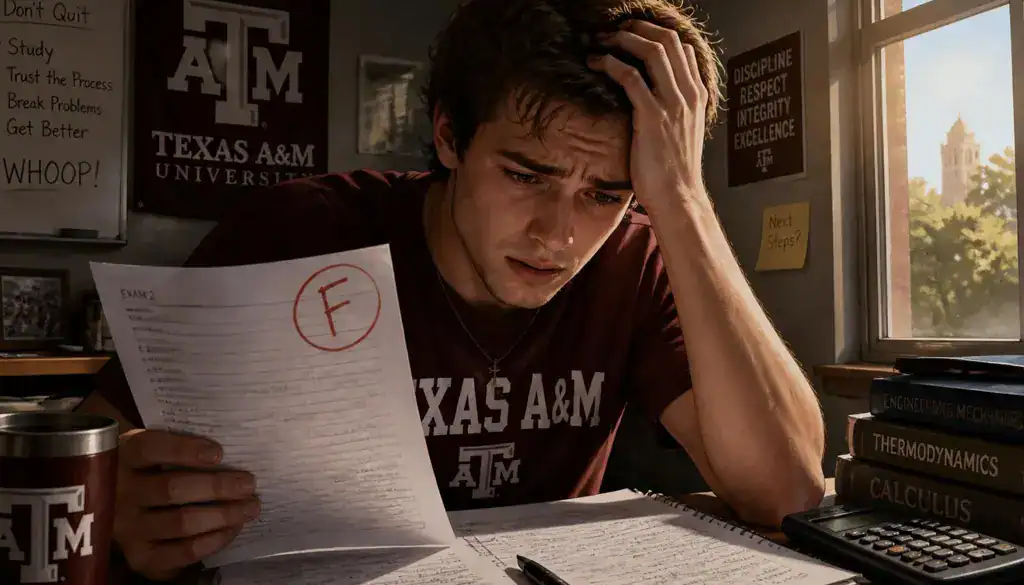
«I watched a student walk into PHYS 206 thinking it was going to be like high school physics — just with harder numbers. He walked out of Exam 1 with a 32% and almost dropped his engineering major that same afternoon.»
If you’re taking PHYS 206 at Texas A&M, I want to be upfront with you before you read a single tip: this course is not hard because physics is hard. It’s hard because of how it’s graded — and most students don’t figure that out until it’s too late.
I’ve tutored enough PHYS 206 students to know that the ones who struggle almost never have a physics problem. They have a system problem. They study the wrong way for the wrong thing. This guide is about fixing that.
What Makes PHYS 206 Different From Every Other Course
Most courses grade you on points. PHYS 206 doesn’t.
It grades you on Learning Objectives (LOs) — specific skills the department decides you need to master. Every exam question is tied to one of those LOs. To pass an LO, you need to answer it correctly at least 60% of the times it appears across all your exams.
This sounds reasonable until you’re sitting with a 40% on Exam 1 and someone tells you it’s “okay, you can still recover.” Here’s the thing — you can recover, but only if you understand the system.
“One student went into Exam 3 with a 10% fraction of achieved LOs. Didn’t Q-drop. Worked hard. Ended the semester with a B.”
— PHYS 206 Department, Texas A&M⚠️ Before You Study Anything
PHYS 206 requires MATH 151 as a prerequisite — and it means it. If derivatives and integrals aren’t second nature yet, review them before your first week. Vectors especially. You’ll use dot products and cross products constantly.
The 7 Topics That Show Up on Every Exam
PHYS 206 covers chapters 1–11, 13, and 14 of Young & Freedman’s University Physics. That’s a lot of material. But after working with students semester after semester, these are the topics where grades are won or lost:
- Newton’s Laws — Every problem comes back to F = ma. Students who understand the why survive the harder problems. Students who memorize the formula hit a wall by week four.
- Work and Energy — The physics is straightforward. The algebra after setting up the equation is where students lose points. Clean up your algebra skills before this unit.
- Conservation of Momentum — Two-dimensional collision problems with angles show up on Exam 2 and trip up students who only practiced one-dimensional versions.
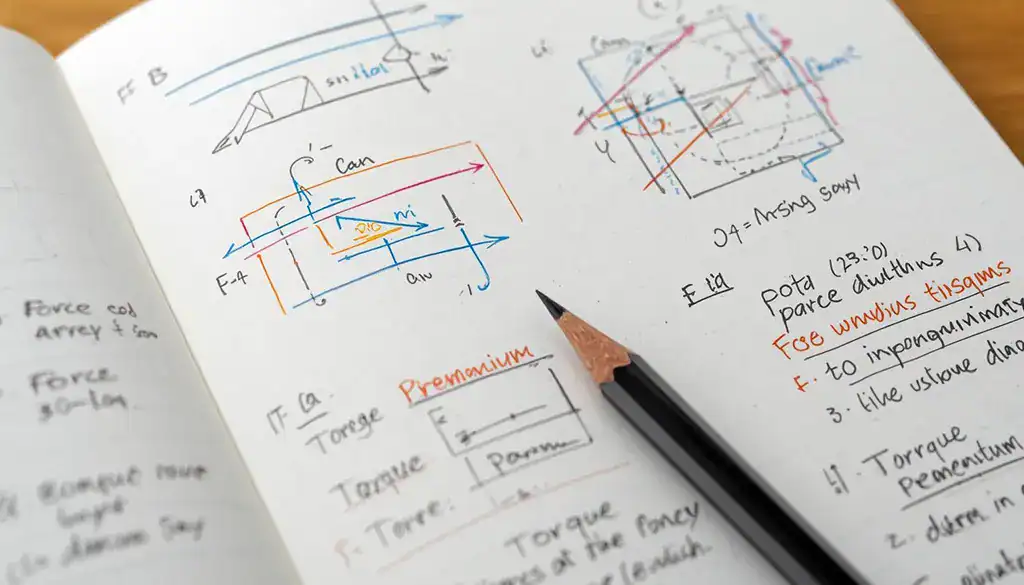
- Rotational Motion — Torque, moment of inertia, angular momentum. Students under-prepare this because it feels abstract. It always appears on the comprehensive.
- Harmonic Motion and Waves — Springs, pendulums, wave equations. Start early — it doesn’t click the first time for most people.
- Vectors — throughout the entire course — This isn’t a single chapter. If you can’t break a force into x and y components quickly and accurately, you’ll lose points on problems you actually understand.
- Free Body Diagrams — The step everyone rushes. Draw it clearly, label every force, take 30 extra seconds here — you’ll make far fewer errors in the math that follows.
Still Struggling With PHYS 206?
Most students turn things around in 1–2 sessions once we identify the real gap.
How the PHYS 206 TAMU Grading System Actually Works
This is the part most students don’t understand until midterms. Read it twice.
Each Learning Objective gets tested multiple times across your exams. At the end of the semester, TAMU looks at how many times you passed each LO versus how many times it was tested. You need ≥60% on each LO to achieve it — or you can pass it on the comprehensive exam alone, which overrides everything.
- A bad Exam 1 is not a death sentence. Seriously.
- The comprehensive exam is your reset button if you use it right.
- Knowing which LOs you’re failing is more valuable than studying randomly.
After every exam, go to your personal PHYS 206 portal at classroom.physics.tamu.edu/mech and look at exactly which LOs you haven’t achieved. Those are your targets. Don’t review what you already know — attack the specific gaps.
💡 The Mistake Most Students Make
They study by chapter. “I need to review Chapter 5 before the next exam.” That’s the wrong approach in PHYS 206. Study by Learning Objective. Find the LOs you failed, go back to the problems tied to those LOs, and practice until you can do them without hesitation.
The PHYS 206 TAMU Study Method That Actually Works
Step 1: Do the Pre-Lectures Before Class — Actually Do Them
PHYS 206 uses a flipped classroom model. The pre-lectures on Mastering Physics are not optional filler. Professors use class time for problem-solving, which assumes you already know the concepts. Walk in cold and you’re lost from minute one.
Step 2: Use the Previous Common Exams — The Right Way
The Physics Department posts every past common exam at classroom.physics.tamu.edu/mech/prev_exams.php. These are gold. But don’t just solve them and move on. For every problem you get wrong, trace exactly where your reasoning broke down — not just what the right answer was.
Step 3: Recitations Are Not Optional
I know they feel like extra work when you’re already overwhelmed. But recitations are where the TAs walk through the exact problem-solving approach the department wants to see. The students who skip them consistently score lower on exams.
Step 4: Office Hours — Come With Specific Questions
“I don’t understand Chapter 7” is not a question. “I can set up the torque equation but I keep getting the wrong sign for the direction of rotation” is. Specific questions get specific help. That’s what actually changes your grade.
Step 5: Build a Mistakes Notebook
Every problem you get wrong — write down the problem, what you did wrong, and the correct reasoning in your own words. Review it two nights before each exam. This single habit has changed more of my students’ grades than any other technique I know.
The Week Before Your PHYS 206 TAMU Exam
Don’t try to learn anything new. If you haven’t mastered a topic by this point, cramming it in the last three days creates confusion, not understanding.
Instead: review your mistakes notebook, do two or three old common exams under timed conditions, and sleep. A well-rested brain that knows 75% of the material outperforms an exhausted brain that “studied” 100% of it every single time.
What To Do If You’re Already Behind in PHYS 206 TAMU
If you’re reading this after a rough first exam, don’t Q-drop yet. Here’s what to actually do:
Go to your PHYS 206 portal and identify your failing LOs. Pick the top three — the ones that appear most on future exams. Work exclusively on those until you can do them cold. Then add more.
The students who recover in PHYS 206 aren’t the ones who suddenly study more hours. They’re the ones who get more specific about what they study. If you’ve tried that and still feel stuck, one or two sessions with a tutor can break the pattern fast — not because the tutor does the work for you, but because an outside perspective spots the gap you’ve been missing.

Quick Summary: How to Pass PHYS 206 TAMU
- PHYS 206 is graded on Learning Objectives, not raw points — understand the system before Exam 1
- A bad first exam is recoverable — the comprehensive exam can override all previous attempts
- Study by LO, not by chapter
- Pre-lectures and recitations are not optional if you want to pass
- Previous common exams at classroom.physics.tamu.edu/mech are your single best resource
- Free Body Diagrams + clean algebra = the two skills that decide most exam points
If you’re also taking MATH 151 this semester — which most PHYS 206 students are — the same gaps that hurt you in calculus will show up here. Read our guide on how to pass MATH 151 at TAMU before your first week. Already past 151? Check out how to survive MATH 152 next. And if you’re on the engineering track, our PHYS 218 guide covers what the mechanics sequence looks like at the honors level.