
If your degree plan at Texas A&M requires MATH 147, 151, or 171, you already know the acronym: the Texas A&M Math Placement Exam, or MPE. It’s the 90-minute test that decides which math course you walk into your first semester — and if you’ve never taken it before, the vague advice floating around incoming-freshman group chats isn’t helping.
This guide breaks down exactly what the MPE tests, who actually has to take it, why students score lower than they expect, and the study plan I walk my own students through before their New Student Conference.
Here’s what’s actually at stake: score 22 or higher and you’re cleared to start in MATH 151 (Calculus I) your first semester — the fastest path through most engineering and science degree plans. Score below that, and you’re placed into a lower course first, which usually means an extra semester before you reach Calculus I.
I’ve tutored dozens of incoming Aggies through the MPE — some retaking it after a first attempt that didn’t go the way they expected. Almost every one of them had the same story: they assumed high school math was enough and didn’t touch trigonometry or logarithms all summer. This guide is here so that isn’t you.
IN THIS GUIDE
What the Texas A&M Math Placement Exam Actually Is
The Math Placement Exam is a 90-minute, non-calculator, proctored exam taken online through Canvas. It doesn’t earn you course credit — it’s strictly a placement tool that acts as the prerequisite for starting in MATH 142, 147, 151, or 171. Your academic advisor uses the result to confirm which course you’re ready to start in.
A few things catch students off guard about the format:
It’s around 33 questions, covering algebra, trigonometry, logarithms, and exponentials — calculus is not tested. No scratch calculator, no notes, no textbooks, no formula sheets, and no web searches are allowed during the exam. You’ll also need a browser other than Internet Explorer.
The exam becomes available about one month before your New Student Conference (NSC), and if you’re admitted into the College of Engineering, you’re required to finish it before you attend. Once you submit, allow 24 hours for your score to show up in Howdy.
The number that matters most is 22. Score 22 or higher and you’re cleared to start directly in MATH 151 (Calculus I) — the fastest track through most engineering and science degree plans at Texas A&M.
Do You Even Need to Take It?
Before you spend a single hour prepping for the Texas A&M Math Placement Exam, confirm you actually have to sit for it. Not every incoming student does.
You’re required to take the MPE if:
Your degree plan requires MATH 147, 151, or 171 — this covers most engineering, science, and pre-professional majors.
Your degree plan requires MATH 142 and you don’t already have credit for MATH 140 (or MATH 1324).
You’ve never attempted MATH 140 or MATH 150 — once you’ve taken either, you’re no longer eligible to take or retake the MPE.
If you’re coming in with AP Calculus credit, dual-credit calculus, or transfer credit that already satisfies your program’s required math course, you may not need the MPE at all — but don’t assume it. Confirm directly with your academic advisor before your NSC. Taking a test you didn’t need to take just wastes one of your two attempts.
If you do need it — keep reading. This guide is for you.
What’s Actually on the Exam
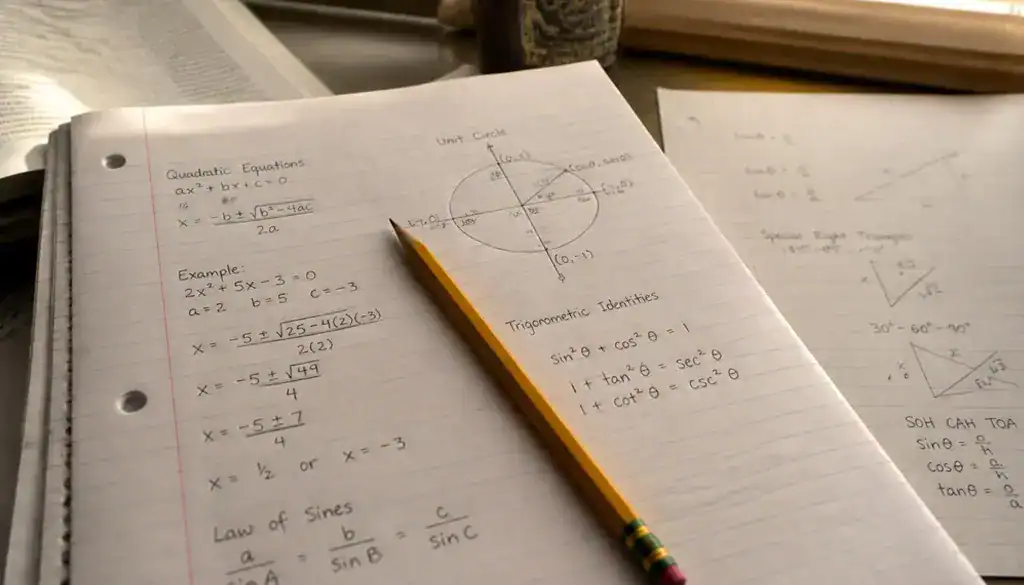
The Texas A&M Math Placement Exam covers three content areas. There’s no calculus on it — which surprises people, since the whole point is placing you into a calculus course. It’s testing whether your foundation underneath calculus is solid.
1. Algebra Fundamentals — Where Points Quietly Disappear
Linear equations, factoring, exponent rules, rational expressions, and solving for a variable inside increasingly messy expressions. This is the section that’s supposed to be “easy review” — and it is, if you’ve touched it recently. If your last algebra class was over a year ago, it’s rustier than you think.
I’ve watched students who scored well in high school algebra freeze on a factoring question simply because they hadn’t done one by hand in months. Speed and accuracy without a calculator both matter here.
2. Trigonometry — The Section Nobody Reviews Over the Summer
Unit circle values, right-triangle trig, basic identities, and graphing sine and cosine. For most incoming freshmen, this was covered a full school year (or more) before test day — and unlike algebra, trig doesn’t come up in daily life to keep it fresh.
Trigonometry is the single biggest reason well-prepared students underscore on the MPE. If you can’t rebuild the unit circle from memory in under two minutes, this is where to spend your first study session.
3. Logarithms and Exponential Functions
Log rules, converting between exponential and log form, and solving basic exponential equations. This section is short, but it’s also the most “forget it exists” topic on the whole exam. A quick review of the three or four core log rules goes a long way here — it’s one of the highest-value, lowest-effort sections to prep.
Why Students Score Lower Than Expected
Most students who don’t hit 22 aren’t bad at math. The Texas A&M Math Placement Exam just exposes gaps most students didn’t know they had, and they fall into one of three patterns — and every one of them is fixable with a week of the right kind of prep.
Treating it like a formality
The MPE gets mentioned in the same breath as a dozen other pre-NSC checklist items, so students walk in cold, assuming senior-year math is fresh enough. It rarely is by August.
A summer-long gap with no math at all
Most students take the MPE two to four months after their last math class. Trig and logs fade fastest during a gap like that — they’re the first things to go and the last things students think to review.
Losing the calculator crutch
High school math leans on a calculator for almost everything. The MPE allows none. Students who haven’t practiced arithmetic and algebra by hand lose time and points on questions they actually know how to do.
The Study Method That Works
You don’t need a semester to get ready for the MPE. You need a focused week that targets exactly what’s tested — nothing more, nothing less.
Take a cold diagnostic
Before opening a single review page, work through the official Texas A&M Math Placement Exam practice set from the Virtual Math Learning Center (VMLC) — no notes, no help. This is where you actually stand, not where you think you stand.
Build your gap list
Write down every problem type that felt shaky — especially in trig and logs, since those fade fastest. That short list is your entire study plan. Ignore everything else.
Drill without a calculator
Every practice problem, done by hand, exactly like test day. If you’re reaching for a calculator during practice, you’re not actually practicing for the MPE.
Simulate real conditions
A day or two before your Texas A&M Math Placement Exam date, do a full practice set start to finish, timed, no interruptions, no phone. Walk in already knowing what 90 minutes of this feels like.
Need Help Prepping for the MPE?
I work with incoming Aggies one-on-one to close their gaps before test day — most students only need one or two sessions to walk in ready for a 22 or higher.
Your 1-Week Prep Plan
Because the MPE only becomes available a month before your NSC — and you’re allowed just two attempts with a mandatory two-week wait between them — you don’t have unlimited runway. Here’s how I’d use one focused week.

Cold diagnostic and gap list
Work through VMLC’s official practice set untimed, no help. Sort every miss into algebra, trig, or logs. This tells you exactly where the rest of the week goes.
Rebuild trig and logs first
45-60 minutes a day. Start with the unit circle and core log rules since these fade fastest — then move to your weakest algebra topics. Do problems by hand, not just watch videos.
Full timed simulation, then rest
Take a complete practice set under real conditions — 90 minutes, no calculator, no interruptions. Review every miss the same day. The night before your real attempt, stop studying and sleep.
Best Free Resources
You don’t need to pay for Texas A&M Math Placement Exam prep. Here’s exactly where I send my own students first.
VMLC Practice Problems
The Virtual Math Learning Center at vmlc.tamu.edu hosts official MPE practice problems for MATH 147, 151, and 171 with matching video walkthroughs — built by the same department that writes the exam.
Official MPE Site
The TAMU MPE Google site covers eligibility, exam rules, and retake policy directly from the math department — read it once before you register.
Khan Academy
Free and organized by topic — search “unit circle,” “logarithm rules,” or “factoring” for short refreshers on exactly what the MPE tests.
VMLC’s Precalculus Program
If your diagnostic score comes in at 70% or below, VMLC runs a paid 3-week live precalculus refresher with tutors — worth it if you have more than a week before your NSC.
Don’t wait until the week of your NSC to start prepping for the Texas A&M Math Placement Exam. You only get two attempts, with a mandatory two-week wait between them — if your first attempt is too close to move-in, you won’t have time to retake it before you need a placement locked in.
Quick Summary: How to Pass the Texas A&M Math Placement Exam
Confirm you need it — required for MATH 147, 151, 171, or MATH 142 without MATH 140 credit
Know the format — ~33 questions, 90 minutes, no calculator, score 22 to place into MATH 151
No calculus is tested — it’s algebra, trigonometry, logarithms, and exponentials
Take a diagnostic first — know your gaps before you study
Prioritize trig and logs — they fade fastest over the summer
Only two attempts — start early, don’t wait until NSC week
Let’s Get You Ready to Start in Calculus I.
One or two sessions is often all it takes to close the gaps that keep students under a 22 on the Texas A&M Math Placement Exam. Let’s find yours before your NSC.
Already placed into MATH 151?
Get ahead before your first week of class — read How to Pass MATH 151. The students who struggle most in Calculus I are the ones who walked in without a plan, the same way they almost walked into the MPE without one.